
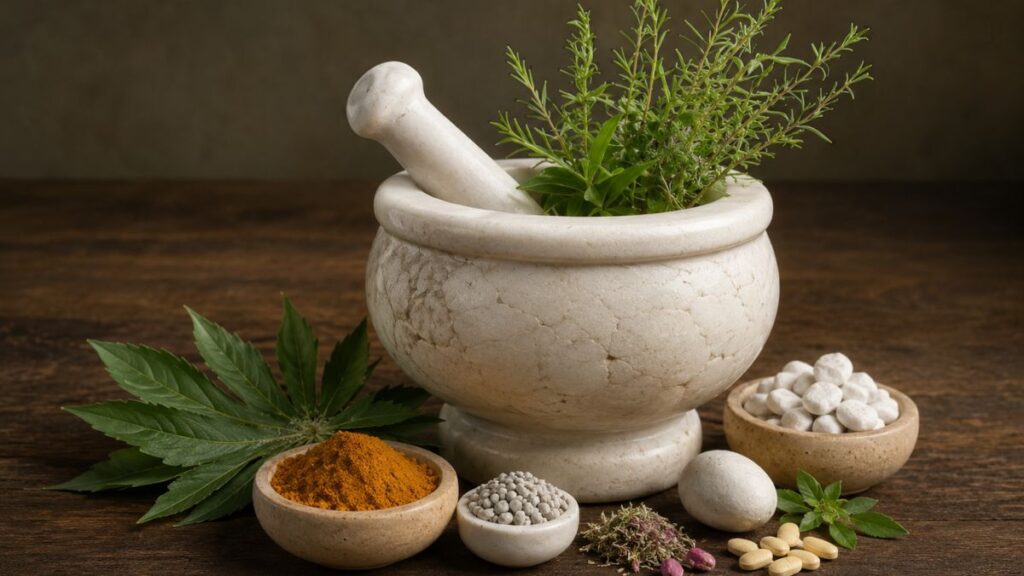
Type “ayurveda” into Google and you’ll land in one of two camps
within three clicks. Camp One treats it like a spiritual system where
Drinking warm water with lemon realigns your “energy”. Camp two,
usually a clinical site, mentions it once and moves straight to a
warning label. Neither one tells you what Ayurveda actually is, how
Indians who grew up with it actually use it, or why some of the
products sold to Americans under that name have landed people in
the ER.
The NCCIH puts the number of American adults currently using it at
roughly 240,000. That’s a real, sizable audience, and most of what’s
written for them online is either marketing copy or a liability
disclaimer. Here’s the version in between.
Take a common scenario: someone picks up ashwagandha at a
supplement shop because a wellness influencer swears by it for
stress, sees “Ayurvedic” on the label, and assumes that word
means something like “third-party tested” or “FDA-checked”. It
doesn’t. It’s closer to how “artisanal” gets stamped on a jar of
peanut butter: a claim about origin and tradition, not a claim about
testing. That gap between what the label implies and what it
What it actually guarantees is where most of this article lives.
Ayurveda is a medical system.
Not a Vibe
Ayurveda is a system of medicine that originated in India roughly
3,000 years ago, built around the idea that health depends on
balance across digestion, waste elimination, and the body’s
underlying constitution. That’s the NCCIH’s working definition, and
it’s worth sitting with, because American wellness culture has
mostly stripped out the “system” part and kept the “balance” part.
In practice, Ayurveda in India looks less like a spa treatment and
more like a parallel healthcare track. Roughly four out of five people
in India draw on it in some form, usually alongside conventional
medicine rather than instead of it—the equivalent of someone in the
US seeing a physical therapist for a bad knee while also taking an
anti-inflammatory their doctor prescribed. Reaching that track
requires actual coursework: India’s National Commission for Indian
System of Medicine accredits Ayurvedic medical colleges set a
multi-year clinical curriculum, and licenses practitioners the way a
A state medical board licenses an MD. It’s a profession with
credentials behind it, the way chiropractic or physical therapy is in
the US.
None of that infrastructure crosses the ocean with the products.
That gap is where most of the American misunderstanding — and
Most of the American risk actually sits there.
Misconception 1: “Dosha Type”
Is Basically a Personality Quiz

Every US wellness site with an Ayurveda section has a dosha quiz.
The questions read like something from a teen magazine: “Do you
have dry skin or oily skin?” “Do you fall asleep easily or lie awake?”
“Are you more likely to skip meals or overeat when stressed?”
Twelve or so of these, then you’re sorted into Vata, Pitta, or Kapha
and shown a supplement bundle to match. It’s the horoscope model
of health content, and it flattens what doshas are actually supposed to
to describe.
In Ayurvedic theory, the three doshas represent functional patterns
in the body, not personality types. Vata governs movement—nerve
signalling, circulation, and elimination. Pitta governs transformation
— digestion, metabolism, and body temperature. Kapha governs
structure and lubrication—tissue, joints, and immunity. An excess of
Anyone is associated with a specific cluster of symptoms: too much
Vata shows up as low energy and digestive irregularity, too much
Pitta as inflammation, and too much Kapha as weight gain and
congestion.
Whether that framework holds up under modern physiology is a
separate, genuinely unresolved question. But even taken on its own
terms, a dosha isn’t a fixed identity you’re assigned once and
market products to forever. Traditional practitioners treat it as a
moving target: the same person might run more Pitta in a stressful,
hot summer at a new job and more Vata during a cold,
sleep-deprived winter with a newborn in the house. A one-time quiz
that permanently labels someone “a Pitta” and sells them a
matching supplement box for life is doing something closer to
astrology than to the system it’s borrowing the vocabulary from.
Misconception 2: “Ayurvedic”
‘On a label’ means ‘regulated’.
and Tested

This is the one that actually matters for safety, and it’s the one most
Beginner-friendly content skips entirely.
In the US, dietary supplement manufacturers don’t need FDA approval.
approval before selling a product. They don’t have to prove the
product works, and in some documented cases, they haven’t even
had to prove it contains what the label says. Oversight is mostly
after the fact—the FDA can act once a product turns out to be
unsafe, not before.
That regulatory gap collided with a specific Ayurvedic practice
called “rasa shastra”: intentionally blending herbs with metals,
minerals, and sometimes gems on the traditional premise that a
cycle of heating and cooling detoxifies the metal and turns it
therapeutic. One well-documented rasa shastra preparation, a
mercury-based ash called Siddha Makaradhwaja, tested at over
85% mercury by weight in lab analysis—not a trace contaminant but
the primary ingredient. A 2004 study out of Boston University tested
70 Ayurvedic herbal products bought from South Asian grocery
stores in the Boston area and found detectable lead, mercury, or
arsenic in 20% of them, in some cases thousands of times above
what the FDA considers safe in food. A follow-up study of products
purchased online found a nearly identical 20% contamination rate,
and it didn’t matter whether the product was manufactured in India
or the US—both groups came back roughly equally likely to contain
toxic metals.
The human cost of that isn’t abstract. A recent case report
describes a 75-year-old woman who showed up at an emergency
room with fatigue and numbness in her hands and feet; the trail led
back to Ayurvedic supplements she’d been taking for an unrelated
condition, three of which tested positive for heavy metals once
Researchers analysed them. That’s not a hypothetical risk.
up to scare beginners off—it’s what shows up in peer-reviewed
case files when nobody checks the bottle first.
To be clear, that 20% figure describes tested herbal products sold in
specific US markets, not Ayurveda as a whole discipline, and it
doesn’t apply evenly across every product type—rasa shastra
formulations carry most of the risk, while plain herbal-only
preparations carry much less. But it’s a real number from a
peer-reviewed source, and it’s the single most important thing a
A beginner should know before buying anything labelled ‘Ayurvedic’.
Online, the label alone tells you nothing about what’s in the bottle.
Misconception 3: It’s Either
“Ancient Wisdom” or
“Pseudoscience”—Pick a Side

American coverage of Ayurveda tends to force a binary that the
evidence doesn’t actually support. Search “turmeric” and
“Ayurveda”, and you’ll find one article calling it a millennia-old
cure-all and another calling the whole tradition unscientific folklore
medicine—and turmeric’s active compound, curcumin, is one of the
more studied botanicals in Western pharmacology, with real (if
modest) anti-inflammatory evidence behind it. The two-camps
framing can’t hold both facts at once, so most writers just pick a
camp. The NCCIH’s own position, after decades of funding trials on
complementary medicine, is neither full endorsement nor full
dismissal: only a small number of well-designed clinical trials have
been published, and the ones that exist are mixed rather than
damning.
A few specific data points, rather than a general verdict: a 2013
randomized trial compared two Ayurvedic herbal formulations
against glucosamine sulfate and the prescription drug celecoxib in
440 people with knee osteoarthritis, and all four treatments
produced similar reductions in pain. A smaller NCCIH-funded 2011
pilot study of 43 people with rheumatoid arthritis found conventional
and Ayurvedic treatment approaches performed comparably.
Neither result proves Ayurvedic herbs work by the mechanism
traditional theory describes dosha balance, which isn’t a framework
Modern trials are built to test, but neither result is nothing either.
What This Actually Means If
You Want to Try It
Ayurveda isn’t something to dismiss wholesale or adopt wholesale.
and beginners are usually pushed toward one or the other by
content written to sell a supplement stack or to protect a publisher
from liability.
Don’t use it to replace or delay conventional care. The NCCIH is
explicit on this point: talk to your regular healthcare provider before
starting anything, especially if you’re pregnant, nursing, or
managing a chronic condition—some Ayurvedic products can
interact with prescription medications or contain ingredients unsafe
during pregnancy.
Check for third-party testing before buying any Ayurvedic
supplement, particularly anything described as a “rasa shastra”.
“Bhasma”, or “ash” preparation—these are the formulations most
associated with heavy-metal content. Herbal-only products carry
meaningfully lower risk.
Know that no US state currently licenses Ayurvedic
practitioners. Unlike in India, where practitioners go through an
accredited medical curriculum, “Ayurvedic practitioner” in the US is
currently an unregulated title. Credentials vary widely, and there’s
No licence to check.
Separate the lifestyle layer from the medical layer. Ayurvedic
tradition recommends eating your largest meal at midday, when
Digestion is considered strongest rather than loading up at dinner.
You don’t have to believe anything about digestive fire to notice that
a lot of sleep-and-digestion research lands in a similar place: late,
heavy meals correlate with worse sleep and reflux, regardless of
which medical tradition you ask. Treat the lifestyle habit and the
theory behind it as separable, and take the habit on its own merits.
FAQs
Is Ayurveda the same as Ayurvedic medicine sold in the US?
stores? Not reliably. The philosophy is the same, but US products
aren’t manufactured under the same regulatory oversight as
licensed Ayurvedic medicine in India, and quality varies enormously.
between brands.
Are all Ayurvedic supplements dangerous? No. The 20% contamination rate applies to tested herbal products, and risk is
concentrated in rasa shastra (metal-containing) formulations
specifically. Plain herbal preparations from reputable,
Third-party-tested brands carry much lower risk.
References:
NCCIH – Ayurvedic Medicine: In-Depth
“Heavy Metal Content of Ayurvedic Herbal Medicine Products.” JAMA, 2004;292(23):2868-2873.
Follow-up online study on heavy metals in Ayurvedic products, JAMA, 2008.
National Commission for Indian System of Medicine (NCISM) – Ayurveda education reforms.