
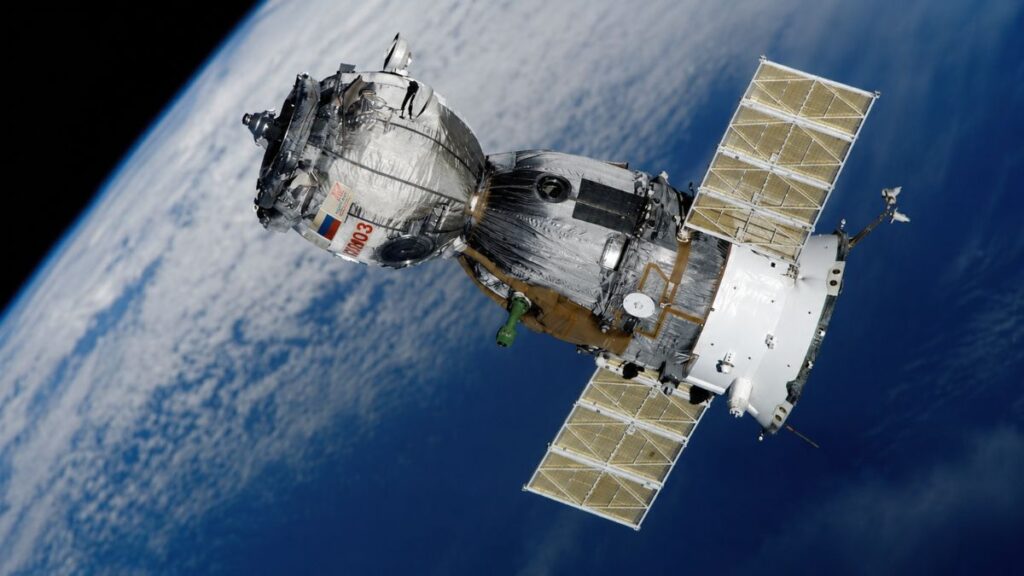
Elon Musk shared the news as he usually does—on X, in the
middle of a sentence, as if it was something everyone already
knew. When SpaceX took over his AI company xAI earlier this
year; he said the idea was straightforward: move the
energy-intensive and space-consuming operations of AI
computing off Earth entirely. “Space is called ‘space’ for a
reason,” he wrote. It sounded like a joke. It wasn’t.
In reality, quietly and at a very high cost, at least eight companies
are already working on real hardware designed to create a space data center.
Not just ideas or sketches. Starcloud recently demonstrated an AI
model running in space using an Nvidia H100 chip. Google has
tested its own satellite processors. Blue Origin, Axiom Space, and
a small Abu Dhabi startup named Madari Space are all in the
process of developing space data centers with similar plans. This isn’t just science fiction anymore—it’s a race, and the goal is clear: who will build the
next foundation of the internet, but this time positioned 300 miles
above Earth?
Let’s explore what a space data centre really is, why it’s
happening now, and whether it has a realistic chance of working
once you stop reading the headlines and start evaluating the
physics.
What Is a Space Data Center, Actually?
Take away the science fiction angle, and it’s not that hard to
understand.
On Earth, data centres are warehouses filled with servers, cooling
systems, and backup power, all designed to store and process
information — like your Netflix queue or a chatbot’s next
response. A space data centre does the same job, but instead of
Being in a building, it’s located on a satellite.
Most of these satellites are placed in low Earth orbit, often in a
specific type of orbit called sun-synchronous, which ensures they
are constantly exposed to sunlight.
That’s the main advantage in one sentence: in space, your solar
Panels never face darkness. There are no clouds, no nights, and
no delays from the power grid. This means a constant, free
source of power — although the cost of launching the hardware
into orbit is not very cheap.
Why Now? Because Earth Is Running
Out of Space
The thing people often miss when they hear “AI data centre” and
Imagine a building full of computers. Is that the real problem?
the computers themselves.
It’s the electricity.
Global data centre energy consumption is expected to reach
around 415 terawatt-hours in 2025, and this number is set to
nearly double by 2030 due to the rising demands of AI training.
The time it takes to get a new facility connected to the power grid
is two years in fast-growing markets like Mumbai and up to ten
years in places like Amsterdam or Tokyo, where the grid is
already at full capacity. Land is in short supply, too, and local
resistance to new data centres has become a major political issue
in many cities.
David Bader, a data science professor at the New Jersey Institute
of Technology, said this in an interview with CNN: the industry is
on the verge of surpassing its ability to generate enough power,
and space may not be a choice but a necessity.
That’s not just hype from a startup founder — it’s academic.
stating that the numbers on Earth are no longer adding up.
Starcloud’s CEO, Philip Johnston, has a more enthusiastic
perspective of the same point — he has argued that space may
eventually make more economic sense than building on the
ground.
He might be right eventually. However, he is also promoting his
own product, so it’s important to remember both sides of the
argument.
Who’s Actually Building This?
The list is longer than most people expect, and it continues to
expand every few months.
Starcloud is arguably the most advanced.
Supported by Nvidia through its startup acceleration programme,
the company placed an H100-class GPU into orbit and used it to
programme and train an AI model—the first time this has been
done in space. They’ve since filed with the FCC for a constellation
of up to 88,000 satellites. In a move that reflects the current mood
in the tech industry, they have also announced plans to mine
Bitcoin on their next satellite. Why not?
Google is also involved with its own initiative, referred to
internally as Project Suncatcher.
This includes radiation-resistant chips and optical links that can
transfer data between satellites at a speed of 1.6 terabits per
second in lab settings. Google’s CEO, Sundar Pichai, has stated
publicly that space-based data centres could become a significant
part of the industry within a decade—not this year or next year,
but as a planned future development.
SpaceX, now merged with xAI, has filed FCC paperwork for a
constellation of millions of satellites.
Blue Origin has responded with its own plan, a 5,400-satellite
network called TeraWave. Axiom Space is integrating orbital data
center nodes into its plans for a private space station. Smaller
players such as Madari Space in the UAE, Sophia Space with its
solar-powered processing tiles, and a European initiative called
ASCEND backed by Thales Alenia Space are all pursuing
smaller, earlier parts of the same opportunity.
Even China is involved, with a government-backed plan for a
200,000-satellite constellation.
This is focused on data sovereignty and in-orbit processing for
time-sensitive government applications.
That’s a lot of names for a technology that most people had never
heard of just eighteen months ago.
How This Would Actually Work
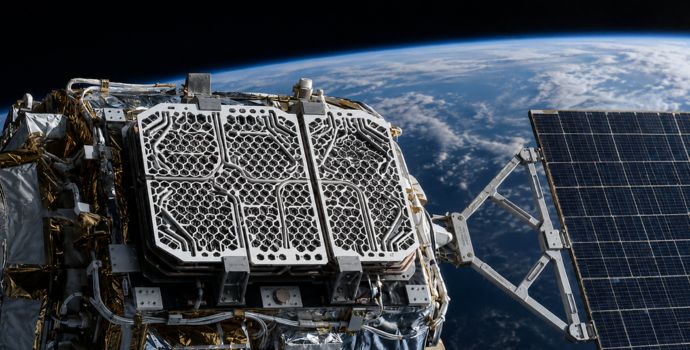
The idea sounds great: an unlimited supply of solar power, with
no need for water, no land conflicts, and no problematic city
meetings.
But the technical challenges behind it are more complicated than
The pitch suggests that the key issue is heat.
On Earth, data centres deal with heat using convection, where air
circulates around hot parts to carry away the heat.
Sometimes water is used to help. In space, however, there’s no
air at all. So satellites can’t use the usual cooling methods.
Instead, they must release heat into space using large radiators.
panels, which means space-based systems require a lot more
surface area than you might expect from something described as
“compact.” A JLL research report notes this as an interesting
paradox: cooling in orbit has minimal ongoing energy costs, but it
requires a lot of upfront materials and mass, which must then be
sent into space at a high cost.
There’s also the issue of radiation.
Space is full of high-energy particles that Earth’s atmosphere
normally blocks, and standard computer chips don’t handle that
well. Companies are trying a middle ground: instead of using
specialised, expensive radiation-hardened chips, some are
protecting commercial-grade GPUs enough to work in space at a
lower cost. This isn’t perfect. Google’s own tests have shown that
These chips still have tiny imperfections. or caused by radiation,
known as “bit flips,” which need extra software to fix.
The Part Nobody Puts On the Slide Deck
When companies talk about the benefits, they usually give a
polished answer.
But when asked about the risks, the conversation tends to get
quieter.
One major risk is space debris.
There are already over 44,000 tracked objects larger than 10
centimeters orbiting Earth. Any one of them could destroy a
satellite. Now imagine adding tens of thousands more satellites.
Starlink alone wants 88,000; SpaceX has applied for over a
million — into a crowded low Earth orbit. The worst-case scenario
is called Kessler Syndrome, a chain reaction where collisions
create more debris, leading to more collisions and possibly
making entire orbital paths unusable for decades. This is not just
Science fiction—it’s a real physical risk that space agencies have
been monitoring since the 1970s, and it’s the main reason
Regulators are watching the space race closely.

Another issue that isn’t discussed enough is the mismatch
between satellite lifespan and chip technology.
Satellites are built to last five to seven years, but AI chips become
outdated in one or two. That means these orbital data centres are
designed for disposal — you can’t easily replace a GPU 300 miles
above Earth like you would a server in a warehouse. Repair and
maintenance in space, known as “on-orbit servicing,” are still in
their early stages. So, every satellite launched today is, in a way,
already on the path to becoming expensive, high-altitude e-waste.
There’s also a less-discussed environmental concern.
Satellites eventually fall back to Earth and burn up, which is
usually harmless. But data center satellites use a lot of aluminum.
and scientists have warned that aluminium particles from reentry
could build up in the upper atmosphere, potentially affecting wind
patterns. Researchers and advocacy groups have directly asked
the FCC about this risk, warning that the effects could be
significant if these satellite constellations are built at the scale
companies are proposing. This is an unusual twist: the pitch for
Space data centers include an environmental angle (less land).
use, no water), but building them at scale might introduce a new
atmospheric problem we don’t fully understand yet.
What Has to Happen Before This Goes
Mainstream
For this to work, one key factor has to change: the cost of
launching something into space.
Right now, launching on a Falcon 9 costs about $2,700 per
kilogram.
SpaceX’s Starship aims for roughly $200 per kilogram — a huge
drop, and industry analysis suggests that around $500 per
kilogram is the breaking point where orbital computing could
become cheaper than building on the ground, even when
considering the shorter satellite lifespan and the cost of sending
data back to Earth.
Beyond cost, the real test will come from operational results, not
just press releases.
Google’s Project Suncatcher satellites are expected to launch
around 2027, and the mission is specifically designed to answer a
straightforward but important question: can AI training actually run
reliably in orbit, with acceptable speed and cost, over a long
period? Not a demo — a real workload, running for real.
Debris management is another major hurdle.
No mega-constellation plan — whether Starlink’s 88,000 satellites
or SpaceX’s proposed mission is sustainable in the long run
without proven, cost-effective systems for safely deorbiting
non-working satellites and cleaning up debris. That technology is
mostly not available yet at the scale needed.
So—Is This Actually Going to Happen?
Probably, but not exactly as the announcements suggest.
The most likely outcome isn’t space data centres replacing
Earth-based ones.
Instead, it’s a division of labor. Orbital systems may handle tasks
that can tolerate delays, like AI model training, batch processing,
big simulations, and data analysis for Earth-observation satellites
already in orbit. Things that require immediate responses — such
as chatbot replies and bank transactions — will remain on the
ground for a long time.
It’s not the dramatic story of “AI data centres in space,” but it’s
likely the real one.
And honestly, a quiet, gradual division of labour between Earth
and space seems more realistic than the idea that a Musk tweet
could be the start of a five-year plan.

Frequently Asked Questions
What is a space data center?
It is a satellite or a planned group of satellites designed to store
and process data in space rather than in buildings on Earth.
These centres operate using solar power and use radiator panels
instead of air conditioning to manage heat, and only send
completed results back to the Earth, not the raw data.
Are space data centers real, or are they just ideas?
It depends on who you ask. Starcloud has already trained an AI
model using an Nvidia H100 chip in orbit, and Google has also
conducted early hardware tests. However, large satellite
constellations, such as StarCloud’s plan of 88,000 satellites, or
SpaceX’s filing for over a million are still several years away from
being built at a large scale.
Why do companies want to place space data centers
rather than Earth?
The main reasons are power and land availability. Space provides
nearly constant solar energy without interruption from weather,
night, or the long wait for a power grid connection. It also avoids
the local opposition that new terrestrial data centers often face.
How do you cool a computer in space when there is no air?
Radiators are used. Since there is no air, heat cannot be removed
through convection. Satellites rely on large panels that release
heat as radiation into the vacuum of space. This method works.
but it requires significantly more surface area and mass compared
to cooling systems on Earth.
What is the biggest risk involved in building space data
centers?
The primary risk for space data centers is space debris. Adding tens of thousands of new satellites to an already busy orbit increases the chances of
collisions. A serious chain reaction, known as Kessler Syndrome,
could make certain parts of low Earth orbit unusable for a long
time. Regulators are closely monitoring this issue for exactly that
reason.
When will space data centers become common?
Most estimates suggest they will be widespread between 2028
and the mid-2030s. This timeline largely depends on launch costs
decreasing to about $500 per kilogram. Google’s own orbital
testing is scheduled for around 2027, which should provide a
clearer picture than any current announcement.
Will space data centers replace the ones on Earth?
Probably not in the near future. A more realistic outlook is a split
between orbital and ground-based systems. Orbital systems will
handle tasks that can tolerate delays, such as AI training or large
batch processing, while tasks requiring immediate responses, like
banking, live chat, and most everyday apps, will remain on the
ground.
References:
“CNN—”These companies want to send data centers into space.”
JLL Research — “Data centers in space” (June 2026)
U.S. Government Accountability Office — “Science & Tech Spotlight: Data Centers in Space” (April 2026)
NewsNation—”Data centers in space: scientists say they could be ‘catastrophic’ for the planet.”
“Phys.org—”Launching the idea of data centers in space” (February 2026)
Wikipedia — “Space-based data center” (company timeline and technical background)
