

The AI field is changing quickly, and new guidelines are emerging—but
not in the way you may think.
Unlike traditional regulations that come all at once, US AI rules are
spreading across different agencies, industries, and even states. If you
run a small business, you might be wondering the following: Do these rules apply to me?
What do I actually need to do?
Here’s the truth: most small businesses aren’t building AI from the
ground up, but many use AI-based tools as part of their daily work, such
as chatbots, marketing automation, and customer data analysis.
That’s why it’s important to understand the rules. This guide helps you
navigate the complexity and explain which regulations currently apply.
which are coming, and what steps you can take now to stay compliant
without spending a lot of money.
The Current State of US AI
Regulation
Unlike Europe’s comprehensive AI Act, the US has not yet passed one
unified AI regulation. Instead, a number of rules are being developed—some focusing on particular uses (like AI in hiring or credit decisions), others on specific
industries (such as healthcare and finance), and still others on general
concerns (like bias, transparency, and data privacy).
This fragmentation brings confusion but also opportunities.
The confusion comes from the lack of a single set of rules. The
opportunities lie in the fact that small businesses often have the chance
to follow best practices before formal rules are in place, helping them
stand out as reliable in their field.
As of early 2025, the regulatory picture is shaped by executive orders
that set general goals, existing laws (like the Fair Credit Reporting Act)
that have been restructured to apply to AI, and agency guidance that
offers direction but does not carry the force of law.
Most importantly, enforcement is just beginning, which means getting
ahead now will prevent future issues.
Key takeaway: Right now, you are not dealing with full AI legislation.
You’re dealing with rules that are forming in specific areas. That’s
It’s actually simpler than it may sound.
Federal Agencies Leading the
Charge
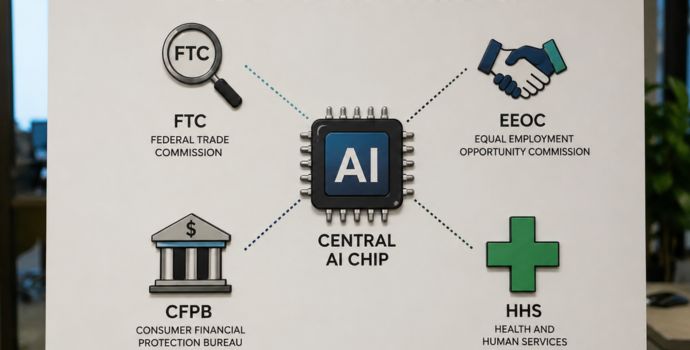
Several federal agencies are getting involved in AI regulation, each
dealing with different issues and business areas.
The FTC (Federal Trade Commission) is the most noticeable.
It uses existing consumer protection laws to look into and penalize
AI-related fraud. For example, if you claim that an AI feature is
“autonomous” when in reality it requires human input, or if you make
false claims about how AI performs, the FTC can take action. Some
smaller companies have already faced consequences for overpromising
AI capabilities.
The EEOC (Equal Employment Opportunity Commission) is focused
on hiring and workplace decisions. If you use AI for hiring, the EEOC expects you to check for bias and document how your tool makes decisions. A case filed in 2024 against a hiring platform showed how lack of transparency in AI tools can break
discrimination laws.
The CFPB (Consumer Financial Protection Bureau) keeps an eye on AI used in lending and financial products. Even if your business isn’t in finance, if you use AI to make customer credit decisions, this applies to you.
HHS (Department of Health and Human Services) has released
guidance on AI use in healthcare. If your business is involved in healthcare—such as telemedicine, platforms, patient tools, or health apps—expect rules around
transparency and accuracy.
Real example: A small recruitment agency used an AI tool to review
resumes and ended up excluding qualified women because the training
The data reflected past hiring biases. The agency faced an EEOC investigation and had to change its process. This could have been avoided with bias testing.
Rules That Already Affect Your
Business
Several current regulations already apply to AI systems.
You don’t need to wait for new laws—these are in effect today.
The Fair Credit Reporting Act (FCRA) requires transparency when AI
is used for credit, employment, or insurance decisions.
If your AI denies someone a loan, you must disclose that and possibly
Explain the reason. This applies not just to banks but also to any
company making automated decisions.
The Americans with Disabilities Act (ADA) now covers AI-driven
tools. If your website uses chatbots, your AI customer service must be
accessible to people with disabilities. Screen readers must work, and if
AI provides important information; it must be understood by users with
assistive technology.
State privacy laws (such as California’s CCPA, Virginia’s CDPA, and
others) govern how AI uses personal data. If you train or use AI tools that handle customer data, these laws define consent, access rights, and data deletion. California has already fined companies for poor privacy practices connected to AI data collection.
COPPA (Children’s Online Privacy Protection) applies if your
The business collects data from anyone under 13.
AI systems that personalize or profile content for children are subject to
stricter rules around transparency and parental consent.
Simple Checklist
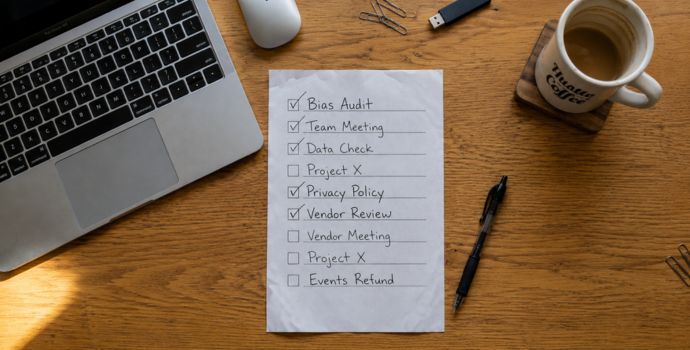
- FCRA: Are you using AI to make decisions about credit or hiring?
- ADA: Is your website accessible to everyone?
- Privacy Laws: Are you following the rules in your state about
collecting and using customer data? - COPPA: Do you have any visitors under 13 years old?
There are four areas for small
businesses.
A. Bias and Discrimination: If your AI is making decisions that affect
people, like hiring or pricing, you need to make sure it is not biased. You
should test your AI. Document what you find and then take steps to fix it.
any problems.
B. Transparency and Disclosure: You need to be honest with your
customers about when they’re interacting with AI. You should review
your marketing claims and make sure they are accurate.
C. Data Privacy and Security: AI systems use a lot of data. You need
to make sure you are collecting and using it properly. You should audit
which customer data you are sharing with AI vendors and make sure you
have the consent and security.
D. Accuracy and Reliability: If your AI is making decisions that affect
people’s lives or finances, you need to make sure it is accurate. You
You should ask your AI vendor about their error rate. When the tool fails.
Some states are making their rules about AI, so you need to stay
informed.
For example, Colorado, Connecticut, and Utah have already
passed laws about AI and privacy. Some industries, like healthcare and
finance, have their own rules about AI.
To prepare your business you
can follow these steps:
Audit: Make a list of the AI tools you use. What they do.
Risk Assessment: Think about which tools pose a risk to your
customers or employees.
Vendor Review: Ask your AI vendors about their bias audit reports
and data retention policies.
Adjustment: Document why you chose each tool and what problem it
Solve and update your privacy policy to disclose AI use.
Monitor Ongoing: Check in quarterly to review regulations and make
sure your AI tools are still accurate and unbiased.
You don’t need to be an expert or hire a lawyer to comply with AI
regulations. You just need to focus on understanding what AI tools you
use, assessing the risk they pose, and documenting your decisions.
Most regulators are not looking to punish businesses that are trying to
act. They are targeting companies that hide AI, make claims, or ignore
obvious bias.
So start by making a list of your AI tools and what they do. Share your
Experience in the comments: What AI tools is your business using? What
Do compliance questions keep you up at night?

FAQ
Q1: Do small businesses have to follow AI regulations?
Yes, small businesses have to follow AI regulations. If you use AI
tools that affect your customers or employees or make decisions, then
You have to follow the rules. The size of your business does not matter.
Even if you are working alone and using AI tools to market your business
You have to make sure these tools are fair and do not deceive people. AI
regulations apply to what you do with AI, not to the size of your
company. Small businesses have to follow AI regulations.
Q2: What is the difference between AI regulations and state-level
rules?
Federal AI regulations apply everywhere in the country. They are not
all in one place. Different agencies like the Federal Trade Commission
and the Equal Employment Opportunity Commission have their rules.
State rules, like the ones in California or New York, only apply in those
states. They can be stricter. It is an idea to follow the strictest rules and
apply them to your entire business. This way you can be sure you are
following all the rules. Federal AI regulations and state-level rules are
different.
Q3: How much will it cost my business to follow AI regulations?
If you are already using AI tools from reputable companies, it will not
cost you a lot. You will need to spend some time looking at what you’re
already doing and making some changes to your privacy policies or
marketing claims. You will only have to spend money if you find out that
one of your AI tools is not working correctly and you need to replace it or
do a big audit to check for bias. You should plan to spend about five to
ten hours per month on this at first. Following AI regulations will cost
your business some time and money.
Q4: What happens if I do not follow AI regulations?
The government is just starting to enforce AI regulations. If you do not
If you follow the rules, you could have to pay a fine. The fine could be
thousands or millions of dollars depending on what you did wrong and
how big your company is. If you do not follow AI regulations, you could
also lose the trust of your customers. You might even be featured in a
news story or have to deal with a lawsuit. If you follow the rules early, it
will show that your business is trustworthy. Not following AI regulations
can have consequences.
Q5: Do I need to tell my customers that I am using AI?
It depends on the situation. If you are using AI to make decisions
about someone, like whether or not to give them credit, you usually have
to tell them. If you are just using AI for things like a customer service
Chatbot, you do not always have to tell them. It is still a good idea to be
Be open with your customers about how you are using AI. This can help
build trust with them. You should tell your customers when you are using
AI to make decisions about them.
Sources & References
- FTC – “Aiming for Truth, Fairness, and Equity in Your Company’s Use of AI”
- EEOC – ADA and the Use of Software, Algorithms, and AI in Hiring
- CFPB – Guidance on Credit Denials by Lenders Using Artificial Intelligence
- HHS – AI Strategy to Transform Agency Operations
- Colorado General Assembly – SB24-205, Consumer Protections for Artificial Intelligence
If you want to read more related news, then visit our world category.