
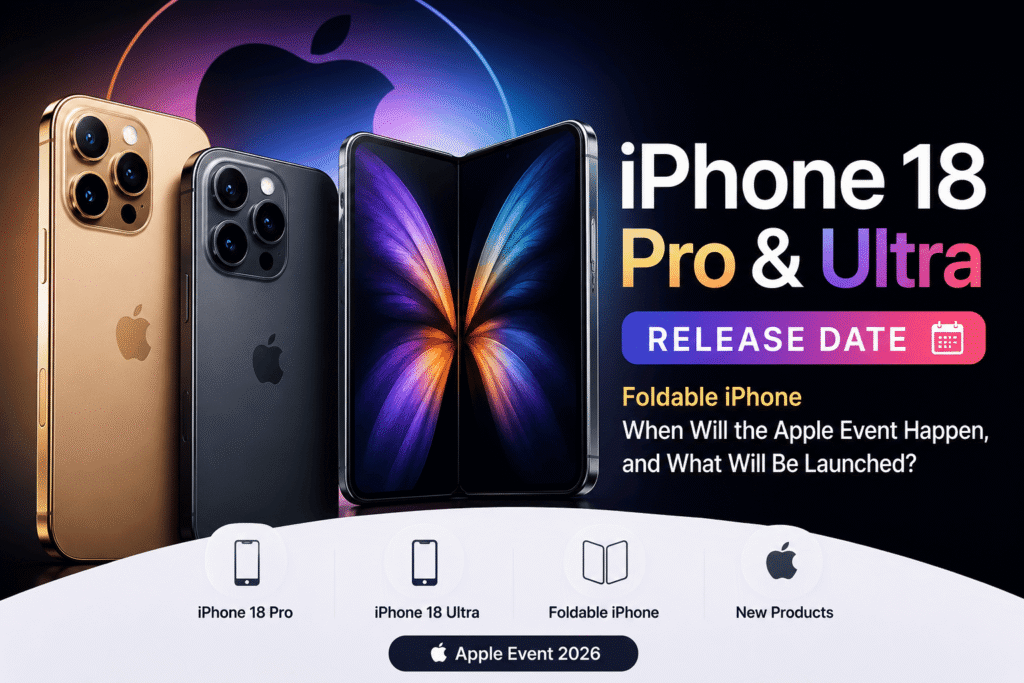
Apple is about to make one of its biggest changes to its hardware lineup in over a decade, and the main question on every user’s mind is, when will the Apple Event happen, and what will Apple be announcing?
The short answer is that Apple hasn’t officially announced a date yet. The more detailed answer, however, is based on past patterns, the layout of the September calendar, and a completely new approach to the iPhone lineup, which suggests a likely week in September 2026. The details are more important than the exact date.
Here is a detailed and up-to-date summary of the iPhone 18 Pro release date, the iPhone Ultra launch, Apple’s new split lineup strategy, and all the features currently believed to be part of the new flagship devices.
When Is the Apple Event? The Most Likely Dates
Since 2012, Apple has maintained a very consistent pattern for its keynotes: iPhone events are typically held in the first half of September, almost always on a Tuesday or Wednesday, and never on September 11, out of respect for the anniversary of a significant event.
The Labor Day holiday, which occurs on the first Monday of September, is also important, as Apple has never scheduled a keynote before that date or on the Tuesday immediately after. This year, Labor Day falls on September 7, which greatly narrows the possible dates. Industry experts have focused on two potential dates:
September 9, Wednesday—the preferred choice for analysts who point out that Apple usually avoids holding keynotes the day after a public holiday, which rules out September 8.
September 8, Tuesday—a possibility suggested by Bloomberg’s Mark Gurman, though some Apple-focused writers argue this breaks from the company’s traditional pattern. If Apple follows its usual habit of announcing the event two weeks in advance, official media invitations are likely to go out around Tuesday, August 25, or Wednesday, August 26. Once the invitation is sent out, the date speculation should end.
The Pre-Order and Shipping Schedule
Apple’s post-keynote schedule is now very standard.
Pre-orders typically start on the Friday following the event at 8 a.m. Pacific (11 a.m. Eastern, 4 p.m. British Summer Time), with devices becoming available to customers the following Friday. Based on the September 9 keynote scenario, we can expect:
Keynote: Wednesday, September 9
Pre-orders open: Friday, September 11
In-store sales and shipping: Friday, September 18
If the keynote is held slightly later, the entire schedule shifts by a week.
Pre-orders would then be around September 18, and sales would begin around September 25. Regardless of the date, the gap between the announcement and pre-order, as well as between pre-order and availability, should remain the familiar two-and-nine-day intervals Apple has used for years.
The Real Story: Apple Is Splitting the iPhone Lineup
This year, Apple is making a significant shift from tradition, and this change is arguably more important than the date itself. For the first time in the smartphone era, Apple is not expected to release the entire iPhone family during the September event.
Instead of the usual four-phone launch (standard, Pro, Pro Max, and a fourth model like last year’s iPhone Air), Apple is expected to introduce only the premium models during the September event:
iPhone 18 Pro
iPhone 18 Pro Max
iPhone Ultra—Apple’s first foldable iPhone
The standard iPhone 18, a budget-focused iPhone 18e, and a second-generation iPhone Air are expected to be released later, around March 2027, as part of a separate spring launch, not alongside the Pro models.
Why is there a change?
Analysts suggest it’s due to production volume. With the foldable joining the lineup, Apple would be managing six different iPhone models in a single year—a number that’s too large for a single keynote and a crowded product display. Splitting the premium and mainstream models allows Apple to focus on its most profitable devices in September while giving the foldable a chance to stand out on its own, rather than be lost among multiple new launches.
There’s also a pricing aspect to consider before making any purchase.
Since all the models introduced in September are premium devices, the entry price for any new iPhone this fall is expected to start at $999 or more. There won’t be a sub-$999 “new” iPhone option until the iPhone 18e and the standard iPhone 18 arrive in the spring of 2027. If you’ve been used to buying the basic model every September, this is the year that routine will be broken.
iPhone Ultra: Apple’s First Foldable
The most anticipated device at this year’s event is not a Pro model but rather Apple’s long-rumored foldable, expected to be called the iPhone Ultra.
Here are a few important facts to keep in mind:
Same-day unveiling, different launch timing.
Analyst Ming-Chi Kuo has suggested that the iPhone Ultra will be presented at the same keynote as the iPhone 18 Pro and Pro Max, but it might not go on sale at the exact same time as the Pro models—rather, it will have a staggered launch.
Production status
Reports from Chinese supply chain sources indicate that the foldable’s design was finalized months ago, and the device is already in mass production, which conflicts with earlier rumors of a delayed launch.
Pricing.
Early estimates suggest the foldable’s price could be above $2,000, placing it as Apple’s most expensive iPhone ever and a clear ultra-premium device rather than a mainstream option.
If you’re new to foldables, think of the iPhone Ultra less as “iPhone 18 but bendy” and more as Apple’s answer to Samsung’s Galaxy Z Fold line—a tablet-sized screen that folds into a compact form, aimed at power users and early adopters willing to pay a significant price for the new format.
iPhone 18 Pro and Pro Max: What’s Changing
The Pro models are expected to keep the same overall shape as last year’s iPhone 17 Pro—with screen sizes of 6.3 inches and 6.9 inches and the same triple-camera setup on the back—but there are a number of changes both under the hood and in terms of design that are rumored to be coming.
Design and display
Smaller Dynamic Island: Face ID’s flood-illuminator is rumored to move beneath the display, allowing Apple to shrink the Dynamic Island cutout without eliminating it. Some display analysts believe a full- under-display Face ID system (no cutout at all) is still a generation or two away.
LTPO+ displays: A refined display technology that should help extend battery life without changing the experience.
Redesigned glass: The Ceramic Shield panel around the MagSafe area is expected to shift to a more frosted, seamless look, replacing the two-tone finish used on the iPhone 17 Pro.
New colors: Leaked Pantone codes point to a lineup of Dark Cherry (the new shade), Light Blue, Dark Gray, and Silver.
Thicker Pro Max: Leaked dummy units suggest the iPhone 18 Pro Max’s camera plateau will grow slightly thicker than both the iPhone 17 Pro Max and the smaller iPhone 18 Pro to accommodate a larger battery.
Camera
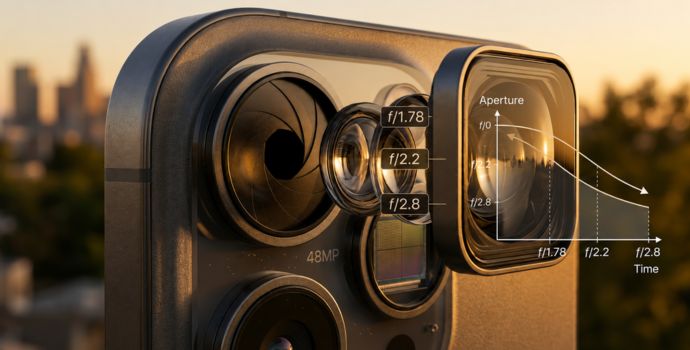
Variable aperture: The 48-megapixel main camera is rumored to gain aperture control, similar to how the human eye adjusts to light. In practice this should mean smoother-looking video in bright outdoor conditions, though the benefit for still photos may be more subtle given the physical size constraints of a phone camera sensor.
Upgraded camera: A 24-megapixel selfie camera is part of the rumor set, an increase over prior generations.
Chips and connectivity
A20 Pro chip: Apple is expected to move to a 2-nanometer manufacturing process for its flagship chip, which should bring efficiency and performance gains.
N2 wireless chip: A successor to the N1 chip that currently powers Wi-Fi 7, Bluetooth 6, and Thread on the iPhone 17 lineup and iPhone Air.
C2 modem: Apple’s next-generation in-house modem is continuing its multi-year push to reduce reliance on Qualcomm. Some reports suggest U.S. units may still ship with Qualcomm modems for mmWave 5G support, while international models adopt Apple’s silicon. A market-by-market split rather than a uniform rollout.
Satellite connectivity: Expanded satellite-based features are also part of the rumor mill building on Apple’s existing emergency SOS and messaging-via-satellite tools.
Other refinements
Simplified Camera Control button: Rumored to drop touch sensitivity and haptic feedback in favor of pressure input, a simplification from the current design.
Battery on the Pro Max: Regulatory filings reportedly point to a capacity increase, which, combined with the LTPO+ display, should meaningfully improve battery life for the larger model.
Camera and Zoom: The Major Photography Enhancement in a Long Time
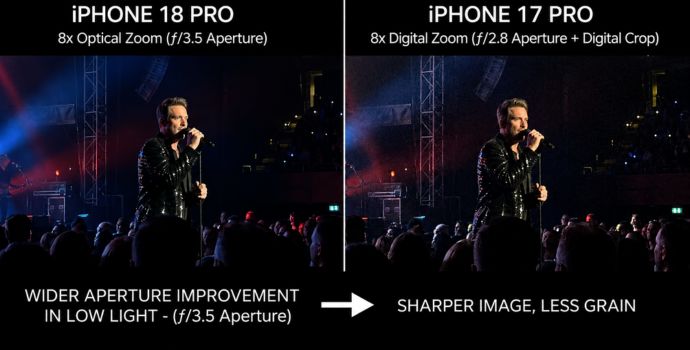
Current baseline (iPhone 17 Pro): this model features an 8x optical-equivalent telephoto lens with a 48-megapixel sensor. However, it has a fixed f/2.8 aperture, which can struggle in low light. This often leads to grainy or soft images when taking photos at high zoom levels during dusk.
What is rumored to change on the iPhone 18 Pro and Pro Max:
Wider telephoto aperture: Several supply-chain sources suggest that the 4x/8x telephoto lens will have a wider aperture than the current f/2.8. This wider opening allows more light in, which should result in sharper and cleaner photos taken in low-light conditions. This area has been a challenge for the iPhone, with most top Android phones performing better.
Variable aperture on the main camera: Unlike the current fixed f/1.78 opening, the 48MP main Fusion camera is expected to have mechanically adjustable aperture control. This allows the camera to widen or narrow its lens, similar to how our eyes adjust in different light conditions. This should give photographers more control over depth of field. The most noticeable benefit is expected to come from smoother, better-exposed video captured outdoors.
Bigger main sensor: There are rumors of a larger 1/1.12-inch main sensor. Combined with the variable aperture, this should significantly improve low-light still photography.
200MP periscope telephoto (early-stage rumor): A Chinese supply-chain leak mentions a 200-megapixel periscope-style ultra-telephoto lens as part of a multi-year camera roadmap.
However, this is described as a future-phase upgrade rather than certain for this September launch, so it should be considered a low-confidence rumor for now.
Teleconverter option: There is also talk about a secondary optical element that could extend the telephoto’s effective reach. However, there is very little confirmed information about this at the moment.
24MP front camera: The front camera is expected to be upgraded from the current selfie camera, offering sharper details in low light. In practice, this could mean photographing a bird from across a park or a stage performer from the back of a venue.
On the iPhone 17 Pro, an 8x zoom shot in dim, early-evening light often results in soft or noisy images. If the wider telephoto aperture rumor is accurate, the iPhone 18 Pro should capture that same 8x shot with less noise and better detail—addressing a real gap between the iPhone and top Android camera phones from the past couple of generations.
The iPhone 18 Pro and iPhone 18 Pro Max are going to be really cool. They have a chip called A20 Pro that is made in a very small way, which is a 2 nm process. The screens are big; the iPhone 18 Pro has a 6.3-inch screen, and the iPhone 18 Pro Max has a 6.9-inch screen. They use something called LTPO+ technology, which helps the battery last longer.
Dynamic Island is smaller now because they moved the Face ID light under the screen. The main camera is very good; it has 48 MP. Can change how much light it lets in. It also has a sensor that is 1/1.12-inch. A telephoto camera is better too; it can zoom in more. Take nicer pictures in the dark. The front camera is 24MP, which is more than the old one. The modem is made by Apple. In the US it might be made by Qualcomm so it can work with 5G.
The wireless chip is called N2, and it can do Wi-Fi 7 and Bluetooth 6. The back of the phone is made of Ceramic Shield. It feels nice. The camera part is a little thicker on the iPhone 18 Pro Max. The colors are dark cherry, light blue, dark gray, and silver. The camera button is simpler now; you just press it. The iPhone 18 Pro Max has a battery.
It might cost $999 or more. iPhone Ultra, which is a foldable phone. It has the kind of chip as the iPhone 18 Pro. The screen is very big, like a tablet, when you unfold it. We do not know much about the Dynamic Island, camera, and front camera yet. It probably has the modem and wireless chip as the iPhone 18 Pro. We do not know the colors or how big the battery is yet. It might cost more than $2,000. Remember, none of this is official until Apple tells us. Some things might not even be in the phones.
FAQ: iPhone 18 Pro and iPhone Ultra Release
When is the Apple Event for the iPhone 18 Pro and iPhone Ultra?
Apple hasn’t announced an official date. Based on 15 years of keynote patterns and this year’s Labor Day placement (September 7), the most likely date
When is the Apple Event for the iPhone 18 Pro and iPhone Ultra?
Apple hasn’t announced an official date. Based on 15 years of keynote patterns and this year’s Labor Day placement (September 7), the most likely date is Wednesday, September 9, 2026, with September 8 floated as a secondary possibility. Official invitations typically go out about two weeks before the event, so expect confirmation around August 25–26.
When do pre-orders start?
If the keynote lands on September 9 as expected, pre-orders should open Friday, September 11, 2026, at 8 a.m. Pacific.
When will the iPhone 18 Pro be available?
Following Apple’s usual one-week gap between pre-orders and availability, the iPhone 18 Pro, iPhone 18 Pro Max, and iPhone Ultra are expected to reach customers and retail stores on Friday, September 18, 2026.
Is the standard iPhone 18 launching in September too?
No. For the first time, Apple is expected to hold back the standard iPhone 18, the budget iPhone 18e, and the second-generation iPhone Air until around March 2027. Only the Pro-tier models and the new foldable are expected in September.
What is the iPhone Ultra?
The iPhone Ultra is Apple’s rumored first foldable iPhone, expected to be unveiled alongside the iPhone 18 Pro and Pro Max, though it may go on sale on a slightly different schedule. Pricing is expected to start above $2,000.
How much will the iPhone 18 Pro cost?
Apple hasn’t confirmed pricing, but because every device launching in September is a premium model, the lowest starting price across the new lineup is expected to be $999 or higher.
What’s the biggest camera upgrade on the iPhone 18 Pro?
The most talked-about change is a wider aperture on the telephoto (zoom) lens, aimed at fixing the iPhone’s long-standing weakness in low-light zoom shots, paired with a variable aperture on the main camera for the first time on any iPhone.
Will the iPhone 18 Pro look different from the iPhone 17 Pro?
Only modestly. Expect the same general size and triple-camera plateau, but with a smaller Dynamic Island, a more seamless frosted rear-glass finish, a new Dark Cherry color option, and a slightly thicker camera plateau on the Pro Max.
Why Apple Is Timing It This Way
Beyond the mechanics of keynote scheduling, there’s a strategic read worth understanding. By holding the September spotlight for Pro and Ultra models only, Apple gets to observe how Samsung’s Galaxy Z Fold and Google’s Pixel lineup land with consumers over the summer, then position its own messaging accordingly. It also concentrates marketing dollars and retail attention on the highest-margin devices in the lineup, effectively using the delayed standard iPhone 18 as a lever to nudge undecided upgraders toward the pricier Pro tier instead of waiting.
For everyday buyers, the practical takeaway is this: if you’re hoping for a new “affordable” iPhone this fall, that phone isn’t coming until spring 2027. Anyone shopping in September will be choosing between the iPhone 18 Pro, iPhone 18 Pro Max, and the iPhone Ultra—with the current iPhone 16e and iPhone 17 lineup remaining the budget-friendly options in the meantime.
Quick Reference: iPhone 18 Pro and iPhone Ultra Timeline
| Milestone | Most Likely Date |
| Media invitations sent | August 25–26, 2026 |
| Apple Event/Knowledge | September 9, 2026 |
| Pre-orders open | September 11, 2026. |
| Devices ship in-store | September 18, 2026. |
References
- MacRumors – iPhone 18 Pro Roundup
- Bloomberg – Mark Gurman •
- Ming-Chi Kuo – iPhone Ultra Launch
- ETNews – Variable Aperture Camera
- AppleInsider—A20 Pro Chip 2nm
To stay updated on technology.