

How to research local candidates is a question many voters ask before election day, especially when they see unfamiliar names on their sample ballot. Fortunately, you don’t need hours of research to make informed decisions. In just 10 minutes, you can evaluate candidates using trusted nonpartisan voter guides, official campaign websites, endorsements, and local news coverage. This guide walks you through the process step by step.
Why Down-Ballot Races Get Skipped So Often
Here’s the pattern researchers keep finding: people vote at the top of the ticket and quietly stop. It’s called ballot roll-off, and it’s been studied for decades.
A Kenyon College analysis of the November 2024 election in Knox County found that voter participation declined with each race further down the ballot. Thousands fewer people voted for a state supreme court seat than for president, even though those voters had already cast their ballots.
The interesting part is that this gap has actually been shrinking. Researchers at the States United Democracy Center found that ballot roll-off has declined significantly since 2012, with far fewer voters leaving down-ballot contests blank than in previous election cycles.
People are catching on that these local races matter. By taking a few minutes to research every candidate, you’re already ahead of the curve and better prepared to cast an informed ballot.
Step 1: Get Your Sample Ballot

Don’t research in the abstract.
Pull your real, actual sample ballot before you do anything else —
You can’t research candidates you don’t know are running.
Most states now let you look this up through your Secretary of
The state’s website uses your name and birthdate or address.
It takes about a minute, and it tells you exactly which races and
ballot measures you’ll see, including the ones nobody’s talking
about.
Write down (or screenshot) every race.
This becomes your research checklist for the next nine minutes.
Step 2: Use Nonpartisan Voter Guides
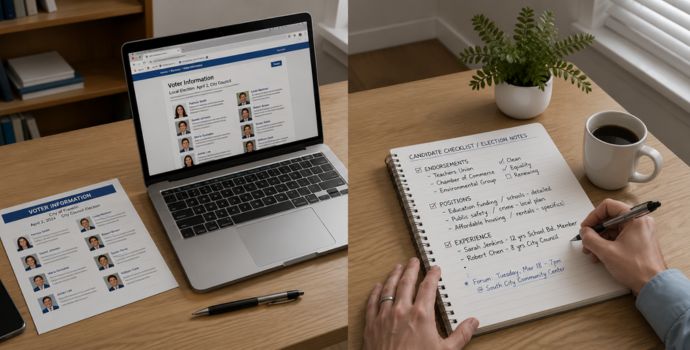
Once you know the names, run each one through a nonpartisan
voter guide.
These sites pull together candidate bios, endorsements, and —
critically — direct quotes from the candidates themselves on
where they stand.
Two worth bookmarking:
Ballotpedia, a ballot-tracking encyclopedia that compiles
candidate filings, past election results, and district maps
Your state or county’s official League of Women Voters guide,
which usually sends candidates a short questionnaire and
publishes the answers side-by-side
This step alone usually tells you whether a race is even
contested, which matters more than people realize—a
Ballotpedia review found roughly half of school board seats in a
The recent cycle had no competition at all.
Step 3: Review the Candidate’s Website
Every candidate site is a marketing document.
Read it anyway—just read it for what’s missing as much as
What’s there?
Look for:
Specific positions on local issues (budget priorities, zoning,
curriculum), not just vibes
Actual professional or civic experience relevant to the seat
Whether the “issues” page reads like it was written for this
specific race or copy-pasted from a template
A vague site isn’t disqualifying by itself.
Plenty of first-time candidates just don’t have a big team. But a
total absence of specifics on a low-stakes local race is worth
noting.
Step 4: Check Local Endorsements
National party endorsements tell you almost nothing about how
Someone will vote on a zoning variance or a school budget.
Local ones tell you a lot more.
Look for endorsements from:
The local teachers’ union or parent-teacher association (for
school board races)
Neighbourhood associations or a local newspaper’s editorial
board
Current or former officials who’ve actually worked alongside the
candidate.
Step 5: Search Local News Coverage
The last step is to search the candidate’s name plus your city or county
name, and set the results to the past year.
You’re looking for local newspaper coverage and meeting minutes, if
they’ve already served in some capacity, or any controversy that
hasn’t made it onto their campaign site (for obvious reasons).
Small local outlets often cover these races in far more depth than
anything national, so don’t skip your community paper or its
website.
If nothing comes up at all — no coverage, no meeting record, no
quotes anywhere—that’s useful information too.
It might mean a genuinely low-profile first-timer, or it might mean
There’s just not much public record to judge them by yet.
Red Flags to Watch For
A few patterns worth pausing on when you spot them:
A candidate who won’t answer a direct nonpartisan questionnaire
at all
Campaign material that’s entirely attack-focused with no actual
platform
Financial disclosures (if required in your state) that don’t match
their stated priorities
An unusually large amount of outside money flowing into what
should be a small local race—worth a quick look at your state’s
campaign finance disclosure site
None of these automatically disqualify someone.
But together, they’re worth weighing against whatever positive
signs you found in steps 2 through 5.

Final Thoughts
Ten minutes is truly enough—not to fully understand every
candidate at the level of a PhD, but to make an informed decision
instead of just guessing.
Get your real ballot, run names through a nonpartisan guide,
briefly review their website with a careful look; check who locally
supports them and does a quick search on the news. That’s all it is.
takes.
If this helps you feel less overwhelmed when voting for lower-level
offices, share it with someone who often leaves part of their ballot
blank.
And if you want a more detailed look at any specific position, start
with our guide on what a school board member actually does.
FAQ
Do I really need to research every race on my ballot?
Not in great detail, but even a quick look at the ones you know
Nothing about it is better than skipping them. Spending ten minutes
On your whole ballot is a realistic goal for most local elections.
What if a race has no information available anywhere?
That’s more common than you might think in small local races. If
there’s no public record at all; that fact itself is a piece of
information — consider it when deciding how much you trust the
seat to someone you don’t know.
Are nonpartisan voter guides really unbiased?
Credible ones, like those from the League of Women Voters, are
created to remain neutral and usually present candidates’ own
statements instead of opinions, which is why they’re a great place
to start.
How do I find my sample ballot if I’ve moved recently?
First, update your voter registration with your new address, then
Look up your ballot through your state’s official election website.
an outdated address is the most common reason people can’t find
the right ballot.
Should campaign donations affect how I judge a candidate?
They can be a helpful clue, especially in small races where a
A sudden increase in outside money is unusual. Most states make
This data is public, and it only takes a minute or two to check.
Resources
Ballotpedia – Candidate Profiles & Election Information
League of Women Voters – Voter Guides & Election Resources
USA.gov – Voting and Elections Guide
Vote.gov – Register to Vote and Election Information
National Association of Secretaries of State (NASS)
For more trusted election guides and political updates, visit our home page, browse the politics category, read about our editorial standards on the About Us page, or reach out via our Contact Us page.