
If you’ve been referred to a specialist and told to expect a wait, the
The honest answer is it depends entirely on where you live.
Two patients with the same condition, referred on the same day, can end
up waiting months apart from each other simply because of their
postcode.
In 2026, the NHS elective waiting list in England has reached over 7
million cases, and the difference between the best- and worst-performing
Trust has never been more noticeable.
This article examines which areas and specialties are struggling the
most, why the postcode lottery exists, and what you can do if your local
Trust is one of the slower ones.
Where the NHS Waiting List
Stands in 2026

The scale of the backlog is still difficult to overstate.
As of May 2026, the Referral-to-Treatment (RTT) waiting list in England
had reached about 7.3 million cases—people waiting for everything from
hip replacements to hearing assessments.
Nationally, only around 61–62% of patients receive treatment within the
18-week target, compared to the official goal of 92%.
This gap between expectation and reality is what causes frustration, and
It’s not spread evenly. Some areas are close to meeting the target, while
Others are still far from it.
The National Picture Is Improving, Slowly
There has been real progress in some regions.
Areas like the East of England have increased their proportion of
patients treated within 18 weeks by several percentage points
year-on-year. However, “improving on average” hides a lot of
variation—which is why judging the NHS based solely on national figures
can be misleading.
National RTT waiting list: approximately 7.3 million cases (May 2026)
National 18-week target: 92% of patients
Actual national performance: roughly 61–62%
Which Areas and Trusts Have
the Longest Waits
This is where the postcode lottery becomes clear.
At the most pressured end, the Mid and South Essex NHS Foundation
Trust recorded a routine trauma and orthopaedic wait of 67.2
weeks—over a year for a non-urgent referral in one of the most common
specialities.
Compare this to trusts close to the target, where the same referral might
be resolved in a fraction of the time.
The difference isn’t about how ill the patients are; it’s mainly about local
capacity, staffing, and how efficiently each trust operates its diagnostic
and booking systems.
The Devolved Nations Face Even Bigger Gaps
The postcode lottery doesn’t end at the English border.
Waiting times in Scotland, Wales, and Northern Ireland are generally
longer than the English average, with Northern Ireland historically having
the longest waits in the UK due to years of underinvestment. Welsh
Waiting times also regularly lag behind the English average.
This has led to a real shift in behavior: self-funded private treatment has
grown most rapidly in the nations with the longest NHS waits.
In Northern Ireland, it has more than tripled since 2019, while in Wales, it
has more than doubled—compared to a much smaller rise in England.
Which Specialties Are Hit
Hardest
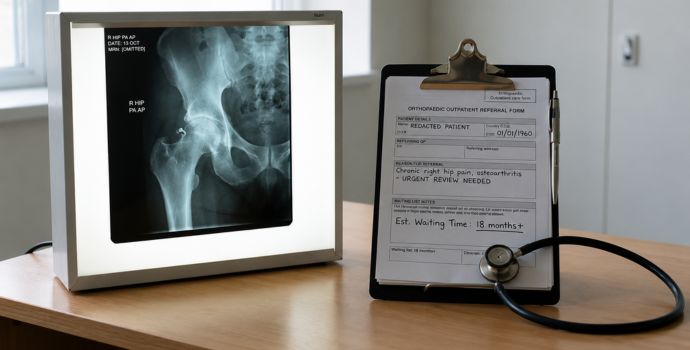
Not every department is struggling equally.
A few specialities consistently rank among the longest waits year after year.
year.
Orthopaedics—hip, knee, and shoulder referrals routinely take 6 to 18
months in many trusts, with knee replacement averaging around 28.7
weeks nationally.
Ophthalmology—cataract surgery waits range from around 8 weeks at
the fastest trusts to well over 45 weeks at the slowest, with some
Scottish health boards reporting routine ophthalmology waits near 59
weeks.
ENT (ear, nose, and throat)—adult tonsil surgery, sinus procedures,
and hearing assessments often face multi-month delays.
Gynecology—both routine and complex referrals—faces widespread
multi-month waits.
CAMHS (children’s mental health)—among the longest waits in the
entire NHS, often stretching beyond a year in some areas.
Why These Specialties Specifically
These departments share a common issue: high demand, limited
specialist theatre or clinic capacity, and a workforce that is expensive
and slow to grow.
Cataract demand alone is expected to increase sharply in the coming
years, meaning the gap is likely to widen before it narrows without
significant investment.
Why the Postcode Lottery
Exists
It’s easy to think that the worst-performing trusts are simply not getting
enough resources compared to the best ones, and that’s part of the
reason—but it’s not the full picture.
Facility design plays a role.
Trusts that have dedicated units focused on one specialty—like a
standalone cataract unit—often manage shorter and more predictable
waiting lists than those that share operating theaters across multiple
departments.
Staffing stability is another factor.
When consultants are consistently available instead of relying heavily on
With temporary staff, patients tend to wait less time.
Digital maturity also makes a difference.
Trusts that have updated patient portals, automated booking systems,
and efficient validation processes often clear backlogs more quickly than
those still using outdated manual methods.
Partnership with independent providers can help as well.
Areas that use contracted independent sector capacity for routine
procedures move patients through the system faster than those that
Don’t.
It’s Not About How Sick an
Area Is
It’s important to be clear: longer waits in a certain area do not mean
Patients are lower priority or less unwell.
The variation in waiting times is mostly due to how services are
structured and managed—not because of the patients’ medical
conditions. This means changes in the right areas can make a big
difference.
Trusts That Are Turning It
Around

The postcode lottery isn’t fixed—some trusts are proving that it can be
closed relatively quickly with the right changes.
The Princess Alexandra Hospital NHS Trust is a real-world example.
In March 2025, about 46% of patients were treated within 18 weeks. By
March 2026, that number had increased to around 64%—an
improvement of nearly 18 percentage points in just one year, driven by
an 8% increase in referral-to-treatment performance since the previous
November.
Nearby, West Suffolk NHS Foundation Trust improved the proportion of
patients receiving diagnostic tests within six weeks from about 40% to
86%, and reduced the number of patients waiting over 18 weeks by
more than 2,000 between August 2025 and March 2026.
What These Trusts Did
Differently
Both examples show similar strategies: improving diagnostic turnaround
times, using digital tools to avoid missed appointments and duplicate
bookings, and focusing more on patients who have been waiting the
longest.
None of these changes required a much larger budget—they just
involved better use of existing resources.
What You Can Do If You’re
Stuck on a Long List
If your local trust is one of the slower ones, you’re not necessarily stuck
with the long waiting times.
Use your legal right to choose.
Patients in England have the right to select any NHS-contracted hospital
for elective treatment, including independent sector providers—ask your
GP to refer you to a faster trust.
Check your specific trust, not the national average.
National and even regional averages can hide large differences between
individual hospitals—always look up your trust’s published waiting times.
Ask about diagnostic-only waits.
Sometimes the diagnostic process—not the treatment itself—is the real
bottleneck—ask where in the pathway the delay occurs.
Consider a 6-week-wait insurance product.
Some insurers offer policies that only pay out once an NHS wait passes
six weeks, which can be useful for conditions where time matters.
Being proactive about where you’re referred is one of the few things
patients can actually control right now.
Conclusion
The NHS waiting list postcode lottery is real and well-documented—and
importantly, not unavoidable.
The gap between a 67-week wait at the slowest trusts and a faster,
well-run department nearby comes down to how services are
managed—not how sick patients are in different parts of the country.
You check trusts like Princess Alexandra and West Suffolk show that
meaningful improvement is possible within a year when the right
changes are made.
If you’re currently waiting, don’t assume the local average applies to
you—check your specific trust, know your right to choose, and ask
questions about where the delay actually occurs.
If this information helped you understand your situation better, share it
with someone else who is experiencing an NHS referral, or explore our
related guide on your right to choose an NHS hospital.
FAQS
What is the NHS waiting list postcode lottery?
It’s a well-known pattern where two patients with the same condition wait
much different lengths of time for NHS treatment, purely because of
which trust or region they are referred to. The gap between the fastest
and slowest trusts can be many months long.
Which NHS trust has the longest waiting times in 2026?
Mid and South Essex NHS Foundation Trust has recorded some of the
longest routine waits, including a 67.2-week wait for trauma and
orthopaedic treatment. However, waiting times can vary a lot, so it’s
It’s worth checking your specific trust’s latest published figures.
Can I choose a different NHS hospital if my local one has long
waits?
Yes. Patients in England have the right to choose any NHS-contracted
hospital for elective treatment, including some independent providers,
and can ask their GP to refer them accordingly.
Which medical specialities have the longest NHS waits right now?
Generally, yes. Waits in the devolved nations, especially Northern
Ireland has historically been longer than the English average, partly
due to long-term underinvestment in capacity.
If you need professional financial guidance, feel free to visit our Contact Us page. Browse more finance news and guides in our WORLD category.
References:
NHS Digital – Consultant-led RTT Waiting Times overview
Office for Statistics Regulation – Review of NHS England’s RTT Statistics
British Medical Association – NHS Backlog Data Analysis
NHS England – “Improvement in the NHS” (long read)